规划与反思:从ReAct到分层规划与自我纠错
1. 为什么 Agent 需要规划和反思
LLM 的核心训练目标是 next-token prediction:给定前文,预测最可能的下一个 token。这种机制天然缺乏两种能力:
- 前瞻(Lookahead):生成第一步时不会考虑"这个决定在第五步会导致什么后果"——每一步都选局部最优,但局部最优的叠加不等于全局最优。
- 回溯(Backtrack):一旦生成了一段文本就不会主动回头修正,即使中间步骤出了错,后续 token 也会基于错误的前提继续生成。
规划(Planning) 弥补前瞻缺陷——在执行前把大目标拆成子目标,考虑步骤间的依赖和顺序。反思(Reflection) 弥补回溯缺陷——在执行后检查结果、分析错误、决定重试或调整。
- 没有规划的 Agent:走一步看一步(Greedy, Reactive)
- 有规划的 Agent:先想好路线再出发(Deliberate, Proactive)
- 有反思的 Agent:走错了能发现、能纠正(Self-correcting)
二者结合,Agent 才能从"工具调用器"进化为"问题解决者"。
2. 规划范式的演进
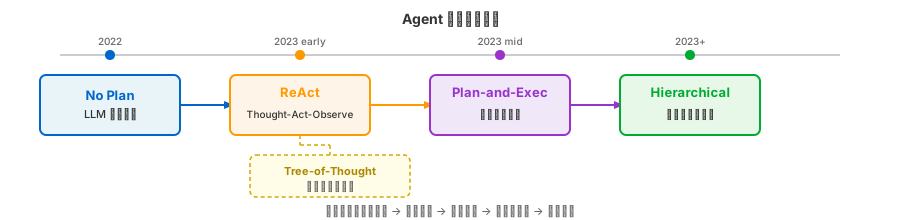
| 范式 | 核心思想 | 解决了什么 | 新的问题 |
|---|---|---|---|
| No Planning | LLM 直接回答 | — | 无法处理多步任务 |
| ReAct | 交替 Thought-Action-Observation | 多步推理+行动 | Greedy,缺乏全局视野 |
| Plan-and-Execute | 先规划再逐步执行 | 全局视野,可追踪 | 计划可能过时,修正成本高 |
| Tree-of-Thought | 多条路径搜索选优 | 探索多种可能性 | 成本倍增 |
| Hierarchical | 多层级递归分解 | 处理真正复杂的任务 | 架构复杂,调试困难 |
3. ReAct 深入分析
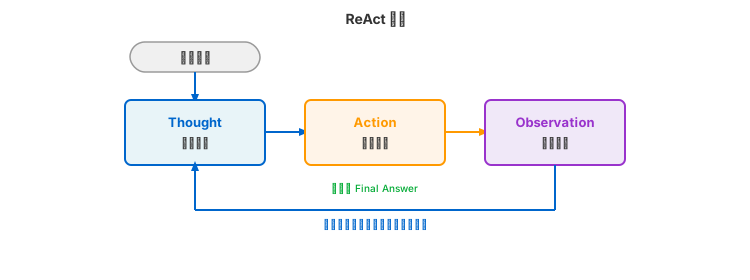
3.1 原理:Reason + Act 交替进行
ReAct(Yao et al., 2022)让 LLM 在推理(Thought)和行动(Action)之间交替,每次行动后观察结果(Observation),再基于观察继续推理。
3.2 ReAct Prompt 模板
REACT_SYSTEM_PROMPT = """You operate in a loop of Thought, Action, Observation.

- Thought: Analyze the situation and decide the next step.
- Action: Call a tool. Format: Action: tool_name({"param": "value"})
- Observation: Review the tool's result.

When ready, respond: Final Answer: <your answer>

Available tools:
{tool_descriptions}

Rules:
1. Always think before acting.
2. If a tool fails, analyze why and try differently.
3. Do not fabricate information — use only tool results.
"""
3.3 优点与缺点
优点:灵活自适应(每步可根据 Observation 调整)、实现简单(while 循环 + prompt)、可解释性强(Thought 暴露推理过程)、容错好(失败后下一步可换策略)。
缺点:Greedy / 短视(不考虑长期后果)、效率低(每步完整 LLM 调用)、上下文膨胀(步骤越多 token 越多)、容易循环(重复同一失败策略)。
3.4 Python 实现
import json
from dataclasses import dataclass
from typing import Callable
import openai

@dataclass
class Tool:
    name: str
    description: str
    parameters: dict
    function: Callable

class ReActAgent:
    def __init__(self, model: str = "gpt-4o", tools: list[Tool] | None = None,
                 max_iterations: int = 10):
        self.model = model
        self.tools = {t.name: t for t in (tools or [])}
        self.max_iterations = max_iterations
        self.client = openai.OpenAI()

    def _build_system_prompt(self) -> str:
        tool_desc = "\n".join(
            f"- {t.name}: {t.description}" for t in self.tools.values()
        )
        return REACT_SYSTEM_PROMPT.format(tool_descriptions=tool_desc)

    def _parse_action(self, text: str) -> tuple[str, dict] | None:
        for line in text.split("\n"):
            if line.strip().startswith("Action:"):
                action_str = line.strip()[len("Action:"):].strip()
                paren = action_str.find("(")
                if paren == -1:
                    return None
                name = action_str[:paren].strip()
                params_str = action_str[paren + 1:].rstrip(")")
                params = json.loads(params_str) if params_str else {}
                return name, params
        return None

    def _execute_tool(self, name: str, params: dict) -> str:
        if name not in self.tools:
            return f"Error: Unknown tool '{name}'"
        try:
            return str(self.tools[name].function(**params))
        except Exception as e:
            return f"Error: {e}"

    def run(self, query: str) -> str:
        messages = [
            {"role": "system", "content": self._build_system_prompt()},
            {"role": "user", "content": query},
        ]
        for _ in range(self.max_iterations):
            resp = self.client.chat.completions.create(
                model=self.model, messages=messages, temperature=0.0,
            )
            text = resp.choices[0].message.content
            messages.append({"role": "assistant", "content": text})

            if "Final Answer:" in text:
                return text.split("Final Answer:")[-1].strip()

            action = self._parse_action(text)
            if action is None:
                messages.append({"role": "user",
                                 "content": "Provide a valid Action or Final Answer."})
                continue

            observation = self._execute_tool(*action)
            messages.append({"role": "user", "content": f"Observation: {observation}"})

        return "Reached max iterations without final answer."
注意:随着迭代增加 messages 不断膨胀,token 消耗呈线性增长。超过 5-6 步的任务需要考虑上下文压缩(如摘要历史步骤)。
4. 如何通过 Prompt 赋予 LLM 规划能力
前面讲的 ReAct、Plan-and-Execute 等范式,本质上都依赖一个前提:LLM 能够生成合理的规划。但 LLM 不是天生就会做规划的——它的训练目标是预测下一个 token,不是"生成最优的任务分解"。规划能力需要通过 Prompt 设计"引导"出来。
这一节专门讨论:怎么写 Prompt 才能让 LLM 产出高质量的计划?
4.1 规划 Prompt 的四个关键要素
一个好的规划 Prompt 需要包含四个部分,缺一不可:
| 要素 | 作用 | 缺失后果 |
|---|---|---|
| 角色定义 | 让 LLM 进入"规划者"心智模式 | LLM 会直接尝试回答问题,跳过规划 |
| 可用资源 | 告诉 LLM 手里有哪些工具和信息 | 生成不可执行的步骤 |
| 输出格式约束 | 强制结构化输出 | 生成自由文本"计划",下游无法解析 |
| 规划质量约束 | 限制步骤数、要求标注依赖 | 过度拆分或步骤间逻辑断裂 |
4.2 一个经过生产验证的规划 Prompt 模板
PLANNER_SYSTEM_PROMPT = """You are a task planner. Your job is to decompose
a user's goal into a sequence of concrete, executable steps.

## Available Tools
{tool_descriptions}

## Planning Rules
1. Each step must be independently executable — no step should assume
   the result of a step that hasn't run yet (unless listed in depends_on).
2. Use the minimum number of steps necessary (aim for 3-7 steps).
   If the task can be done in 2 steps, don't create 5.
3. Every step that calls a tool MUST specify which tool to use.
4. Steps without a tool should be reasoning/synthesis steps.
5. Mark dependencies explicitly — if step 3 needs step 1's output,
   include "depends_on": [1].
6. The final step should always be a synthesis/answer step, not a tool call.

## Output Format
Return valid JSON only:
{{
  "analysis": "One sentence: why this goal needs planning (vs direct answer)",
  "steps": [
    {{
      "id": 1,
      "description": "Clear action description",
      "tool": "tool_name or null",
      "depends_on": [],
      "expected_output": "What this step should produce"
    }}
  ]
}}"""
几个值得注意的设计决策:
"analysis" 字段强制 LLM 在生成计划之前先思考"这个任务是否需要规划"。这避免了过度规划——有些简单问题不需要 5 步计划,LLM 在分析后会自然减少步骤数。
"expected_output" 字段要求每步预估输出。这迫使 LLM 思考步骤间的数据流动,减少"步骤 3 需要步骤 2 的结果,但步骤 2 根本不会产生这个结果"的逻辑断裂。
步骤数限制(3-7 步)很关键。没有这个约束,LLM 倾向于生成 10-15 步的过度拆分计划,每步做的事微不足道,反而增加执行失败的概率。
4.3 Few-shot 示例的作用
仅靠 System Prompt 的规则描述,LLM 生成的计划质量波动较大。加入 1-2 个 few-shot 示例可以显著提升一致性:
PLANNING_FEWSHOT = """
## Example

User goal: "Compare the pricing and features of AWS Lambda vs Google Cloud Functions for a startup processing 1M requests/month"

Plan:
{
  "analysis": "This requires gathering data from two sources and then comparative analysis",
  "steps": [
    {
      "id": 1,
      "description": "Search for AWS Lambda pricing tiers and compute costs at 1M requests/month scale",
      "tool": "web_search",
      "depends_on": [],
      "expected_output": "Lambda pricing breakdown: free tier, per-request cost, compute duration cost"
    },
    {
      "id": 2,
      "description": "Search for Google Cloud Functions pricing and equivalent compute costs",
      "tool": "web_search",
      "depends_on": [],
      "expected_output": "GCF pricing breakdown at same scale"
    },
    {
      "id": 3,
      "description": "Search for feature comparison: cold start, language support, max execution time, concurrency limits",
      "tool": "web_search",
      "depends_on": [],
      "expected_output": "Side-by-side feature matrix"
    },
    {
      "id": 4,
      "description": "Synthesize pricing and feature data into a recommendation for a startup context",
      "tool": null,
      "depends_on": [1, 2, 3],
      "expected_output": "Comparative table + recommendation with reasoning"
    }
  ]
}
"""
这个示例传递了几个隐含标准:步骤 1-3 没有依赖关系(可并行),只有最后的综合步骤依赖前面所有步骤;工具调用步骤有明确的 tool 名;步骤数量合理(4 步而不是 10 步)。
4.4 提升规划质量的三个 Prompt 技巧
技巧 1:逆向规划(Goal Decomposition)
对于复杂目标,让 LLM 从目标倒推比从起点正推效果更好:
REVERSE_PLANNING_HINT = """Before creating the plan, think backwards:
- What does the final deliverable look like?
- What information/data is needed to produce it?
- Where does that information come from?
Then order the steps from data gathering → processing → synthesis."""
技巧 2:失败预判
让 LLM 在生成计划时就考虑"哪一步最可能出错",提前安排 fallback:
ROBUSTNESS_HINT = """For each step, briefly consider: what if this step fails
or returns incomplete data? If a step has a high failure risk, add a fallback
note in the description (e.g., 'If API returns empty, try alternative search query')."""
技巧 3:限制规划深度
当任务模糊时,LLM 容易陷入过度规划。用一个预判步骤过滤:
def should_plan(task: str, llm_client) -> bool:
    """判断任务是否需要多步规划"""
    resp = llm_client.complete(
        f"Can this task be completed in a single tool call or direct answer? "
        f"Reply YES or NO only.\n\nTask: {task}"
    )
    return "NO" in resp.upper()
4.5 规划提示的常见失败模式
| 失败模式 | 现象 | 修复方式 |
|---|---|---|
| 过度拆分 | 10+ 步骤,每步做的事太细碎 | 加步骤数上限约束 |
| 幻觉工具 | 引用不存在的工具名 | 在 Prompt 中列出完整的工具列表,加 "ONLY use tools from the list above" |
| 循环依赖 | Step 3 依赖 Step 5,Step 5 依赖 Step 3 | 加约束 "depends_on must only reference steps with smaller ids" |
| 跳过综合 | 所有步骤都是工具调用,没有最终综合 | 加约束 "final step must be a synthesis step with tool: null" |
| 忽略并行 | 所有步骤串行依赖 | 在 few-shot 示例中展示并行步骤模式 |
规划 Prompt 和其他 Prompt 工程一样,需要迭代。先跑 20-30 个真实任务,收集失败 case,逐步把约束和示例补进去。不存在一个"万能规划 Prompt"——但上面这套框架可以覆盖大部分场景的 80%。
5. Plan-and-Execute 模式
5.1 原理:先规划再执行
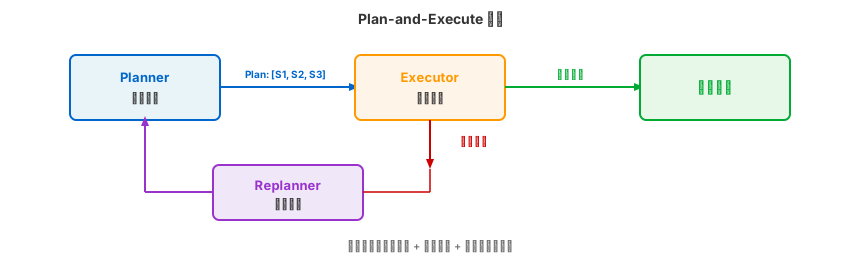
Plan-and-Execute 将规划与执行分离:先用一次 LLM 调用生成完整计划,再逐个执行子任务,必要时触发 Replanning。
5.2 Planner / Executor 分离的优势
- 关注点分离:Planner 负责"做什么",Executor 负责"怎么做",可以分别用不同模型优化
- 可并行:无依赖的步骤可以并行执行
- 可追踪:计划本身是结构化数据,便于监控和审计
- 可中断恢复:执行到一半中断后可从某一步重启
5.3 计划的动态修正
三种 Replan 策略:完全重新规划(全局优化但可能丢弃已有成果)、局部修正(成本低但可能保留错误前提)、条件触发(仅在步骤失败或偏差超阈值时 Replan)。生产中通常用条件触发 + 局部修正的组合。
5.4 Python 实现
from dataclasses import dataclass, field

@dataclass
class PlanStep:
    id: int
    description: str
    tool: str | None = None
    depends_on: list[int] = field(default_factory=list)
    status: str = "pending"   # pending / completed / failed
    result: str | None = None

PLANNER_PROMPT = """Decompose the goal into concrete steps (max 7).
Available tools: {tool_names}
Output JSON: {{"goal": "...", "steps": [{{"id": 1, "description": "...",
"tool": "tool_name or null", "depends_on": []}}]}}"""

class PlanAndExecuteAgent:
    def __init__(self, tools: dict[str, Tool],
                 planner_model: str = "gpt-4o",
                 executor_model: str = "gpt-4o-mini",
                 max_replans: int = 3):
        self.tools = tools
        self.planner_model = planner_model
        self.executor_model = executor_model
        self.max_replans = max_replans
        self.client = openai.OpenAI()

    def _create_plan(self, goal: str) -> list[PlanStep]:
        resp = self.client.chat.completions.create(
            model=self.planner_model,
            messages=[
                {"role": "system", "content": PLANNER_PROMPT.format(
                    tool_names=", ".join(self.tools.keys()))},
                {"role": "user", "content": goal},
            ],
            response_format={"type": "json_object"},
        )
        data = json.loads(resp.choices[0].message.content)
        return [PlanStep(**s) for s in data["steps"]]

    def _execute_step(self, step: PlanStep, context: dict) -> str:
        if step.tool and step.tool in self.tools:
            param_resp = self.client.chat.completions.create(
                model=self.executor_model,
                messages=[{"role": "system", "content":
                    f"Call tool '{step.tool}' for: {step.description}\n"
                    f"Context: {json.dumps(context)}\nReturn JSON params only."}],
                response_format={"type": "json_object"},
            )
            params = json.loads(param_resp.choices[0].message.content)
            return str(self.tools[step.tool].function(**params))
        resp = self.client.chat.completions.create(
            model=self.executor_model,
            messages=[{"role": "user",
                       "content": f"Task: {step.description}\nContext: {json.dumps(context)}"}],
        )
        return resp.choices[0].message.content

    def run(self, goal: str) -> str:
        steps = self._create_plan(goal)
        context = {}
        for replan in range(self.max_replans + 1):
            for step in steps:
                if step.status == "completed":
                    continue
                deps_met = all(
                    any(s.id == d and s.status == "completed" for s in steps)
                    for d in step.depends_on
                )
                if not deps_met:
                    continue
                try:
                    step.result = self._execute_step(step, context)
                    step.status = "completed"
                    context[f"step_{step.id}"] = step.result
                except Exception as e:
                    step.status = "failed"
                    step.result = str(e)
                    steps = self._replan(goal, steps, step)
                    break
            if all(s.status == "completed" for s in steps):
                return self._synthesize(goal, context)
        return "Exceeded max replans."

    def _replan(self, goal, steps, failed) -> list[PlanStep]:
        # 将已完成步骤 + 失败信息交给 Planner 重新规划
        completed = [{"id": s.id, "result": s.result}
                     for s in steps if s.status == "completed"]
        resp = self.client.chat.completions.create(
            model=self.planner_model,
            messages=[{"role": "user", "content":
                f"Replan. Goal: {goal}\nCompleted: {json.dumps(completed)}\n"
                f"Failed step: {failed.description} -> {failed.result}"}],
            response_format={"type": "json_object"},
        )
        data = json.loads(resp.choices[0].message.content)
        return [PlanStep(**s) for s in data["steps"]]

    def _synthesize(self, goal, context):
        resp = self.client.chat.completions.create(
            model=self.planner_model,
            messages=[{"role": "user",
                       "content": f"Goal: {goal}\nResults: {json.dumps(context)}\n"
                       "Synthesize a final answer."}],
        )
        return resp.choices[0].message.content
Planner 用 gpt-4o(强规划),Executor 用 gpt-4o-mini(快执行)——这是生产中常见的成本优化手段。
6. Tree-of-Thought
6.1 原理
Tree-of-Thought(ToT,Yao et al. 2023)模拟人类"深思熟虑":同时考虑多条推理路径,评估每条的前景,选择最优的继续深入。
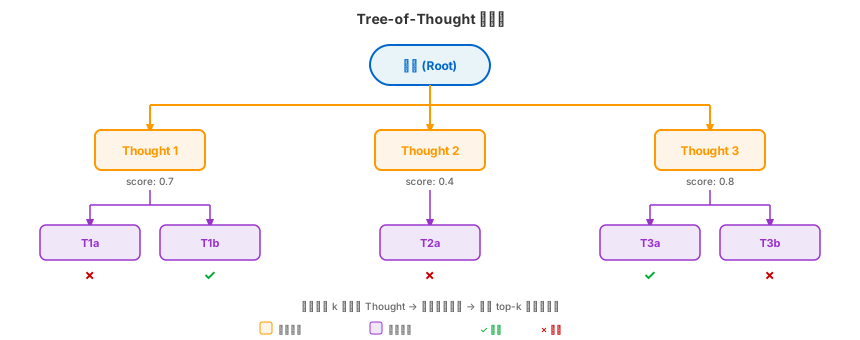
三个核心组件:Thought Generator(每步生成 k 个候选)、State Evaluator(对候选打分)、Search Algorithm(BFS 或 DFS)。
6.2 BFS vs DFS
- BFS:每层展开 k 个,评估后保留 top-k 进入下一层。适合步骤少、每步选择多的问题。总调用 ≈ k x depth x 2(生成+评估)。
- DFS:选当前最优一路深入,死胡同时回溯。适合步骤多、每步选择少的问题。最好 O(depth),最坏 O(k^depth)。
6.3 评估函数设计
- LLM 自评:让 LLM 对每个 Thought 打分。简单但可能有系统性偏见。
- 投票法:多次评估取多数。更稳健但成本更高。
- 外部验证:可验证的问题(数学/代码)用外部工具检查。最可靠但适用范围有限。
6.4 Trade-off:质量 vs 成本
| 方法 | LLM 调用次数 | 质量 | 适用场景 |
|---|---|---|---|
| ReAct(单路径) | O(steps) | 基准 | 大多数任务 |
| ToT-BFS | O(k × d × 2) | 高 | 创意/数学/方案选型 |
| ToT-DFS | O(k^d) 最坏 | 中-高 | 深度推理 |
k=3, d=3 时 ToT 可能需要 40+ 次 LLM 调用,ReAct 只需 5-6 次——8-10 倍成本差距。只有当正确性要求高且存在多条有意义的推理路径时,ToT 的投入才有回报。
6.5 Python 实现
import json
from dataclasses import dataclass, field
import openai

@dataclass
class ThoughtNode:
    """搜索树中的节点,每个节点代表一条推理路径的当前状态"""
    state: str                           # 当前推理状态(累积的 thought 文本)
    score: float = 0.0                   # 评估函数打分
    depth: int = 0
    children: list["ThoughtNode"] = field(default_factory=list)

class TreeOfThought:
    def __init__(self, model: str = "gpt-4o", k: int = 3, max_depth: int = 3):
        """
        k: 每层生成的候选 thought 数量(BFS 宽度)
        max_depth: 搜索树最大深度
        """
        self.model = model
        self.k = k
        self.max_depth = max_depth
        self.client = openai.OpenAI()

    def generate_thoughts(self, problem: str, current_state: str) -> list[str]:
        """生成 k 个候选 thought"""
        resp = self.client.chat.completions.create(
            model=self.model,
            messages=[{"role": "system", "content":
                f"Given the problem and current reasoning state, "
                f"generate exactly {self.k} distinct next-step thoughts.\n"
                f'Return JSON: {{"thoughts": ["thought1", "thought2", ...]}}'},
                {"role": "user", "content":
                f"Problem: {problem}\nCurrent state: {current_state or '(start)'}"}],
            response_format={"type": "json_object"},
        )
        data = json.loads(resp.choices[0].message.content)
        return data["thoughts"][:self.k]

    def evaluate_thought(self, problem: str, state: str) -> float:
        """评估当前推理状态的前景,返回 0-1 分数"""
        resp = self.client.chat.completions.create(
            model=self.model,
            messages=[{"role": "system", "content":
                "Evaluate how promising this reasoning state is for solving the problem.\n"
                'Return JSON: {"score": 0.0-1.0, "reason": "..."}'},
                {"role": "user", "content":
                f"Problem: {problem}\nReasoning so far: {state}"}],
            response_format={"type": "json_object"},
        )
        data = json.loads(resp.choices[0].message.content)
        return float(data["score"])

    def solve(self, problem: str) -> str:
        """BFS 搜索:每层生成 k 个候选,评估后保留 top-k 进入下一层"""
        # 初始化:根节点
        current_level = [ThoughtNode(state="", depth=0)]

        for depth in range(self.max_depth):
            candidates: list[ThoughtNode] = []

            for node in current_level:
                # 为每个节点生成 k 个候选 thought
                thoughts = self.generate_thoughts(problem, node.state)
                for thought in thoughts:
                    new_state = f"{node.state}\nStep {depth+1}: {thought}".strip()
                    score = self.evaluate_thought(problem, new_state)
                    child = ThoughtNode(state=new_state, score=score, depth=depth+1)
                    node.children.append(child)
                    candidates.append(child)

            # 保留 top-k 进入下一层(BFS 剪枝)
            candidates.sort(key=lambda n: n.score, reverse=True)
            current_level = candidates[:self.k]

        # 返回最终得分最高的推理路径
        best = max(current_level, key=lambda n: n.score)
        return best.state
核心观察:BFS 宽度 k 和搜索深度 max_depth 共同控制质量-成本的 trade-off。k 越大,每层探索的候选越多,找到好路径的概率越高,但 LLM 调用次数以 O(k² × d) 增长(每层 k 个节点各生成 k 个候选 + k 次评估)。实践中 k=23、depth=23 是较好的起点,可根据任务复杂度动态调整。
7. 分层规划(Hierarchical Planning)
当任务复杂到"设计并实现用户权限系统"这种级别时,一层计划无法覆盖从架构到实现的所有粒度。分层规划通过递归分解解决:高层拆子目标,低层拆具体动作。
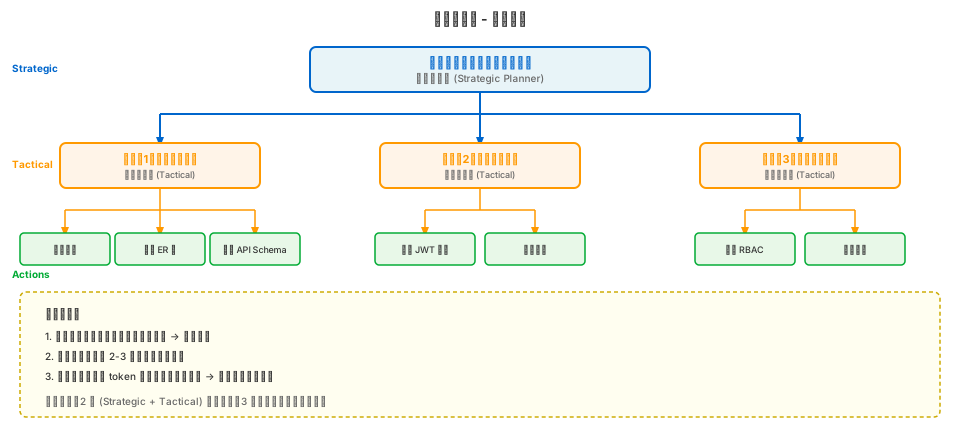
7.1 递归分解的终止条件
- 原子性:任务可用单次工具调用完成 → 停止分解
- 深度限制:最大 2-3 层,防止过度分解
- 预算约束:剩余 token 预算不足以继续分解 → 当前粒度直接执行
class HierarchicalPlanner:
    def __init__(self, client: openai.OpenAI, model="gpt-4o", max_depth=3):
        self.client, self.model, self.max_depth = client, model, max_depth

    def decompose(self, goal: str, depth: int = 0) -> dict:
        if depth >= self.max_depth:
            return {"type": "action", "description": goal}

        resp = self.client.chat.completions.create(
            model=self.model,
            messages=[{"role": "system", "content":
                "Decide if this goal is atomic or compound.\n"
                'Atomic: {"type":"action","description":"..."}\n'
                'Compound: {"type":"goal","description":"...","subgoals":["...",]}'},
                {"role": "user", "content": goal}],
            response_format={"type": "json_object"},
        )
        node = json.loads(resp.choices[0].message.content)
        if node["type"] == "action":
            return node
        node["children"] = [self.decompose(sg, depth+1) for sg in node.get("subgoals",[])]
        return node
实践中 2 层(Strategic + Tactical)通常够用。3 层以上的调试成本会快速失控。
7.2 执行层:递归执行分解后的计划
HierarchicalPlanner 只负责分解,执行需要单独的 Executor。核心逻辑:叶节点(type="action")直接调用 LLM 或工具执行,分支节点(type="goal")递归执行所有子节点并聚合结果。
@dataclass
class ExecutionResult:
    description: str
    output: str
    success: bool
    children: list["ExecutionResult"] = field(default_factory=list)

class HierarchicalExecutor:
    def __init__(self, client: openai.OpenAI, model: str = "gpt-4o-mini",
                 tools: dict[str, Callable] | None = None):
        self.client = client
        self.model = model
        self.tools = tools or {}

    def execute(self, node: dict) -> ExecutionResult:
        """递归执行分解后的计划树"""
        desc = node.get("description", "")

        # 叶节点:直接执行
        if node["type"] == "action":
            output = self._execute_action(desc)
            return ExecutionResult(description=desc, output=output, success=True)

        # 分支节点:递归执行所有子节点
        child_results = [self.execute(child) for child in node.get("children", [])]
        all_success = all(r.success for r in child_results)

        # 聚合子节点结果
        summary = self._aggregate(desc, child_results)
        return ExecutionResult(
            description=desc, output=summary,
            success=all_success, children=child_results,
        )

    def _execute_action(self, action: str) -> str:
        """执行单个原子动作——优先使用工具,否则 fallback 到 LLM"""
        for tool_name, tool_fn in self.tools.items():
            if tool_name.lower() in action.lower():
                return str(tool_fn(action))
        resp = self.client.chat.completions.create(
            model=self.model,
            messages=[{"role": "user", "content": f"Execute this task: {action}"}],
        )
        return resp.choices[0].message.content

    def _aggregate(self, goal: str, results: list[ExecutionResult]) -> str:
        """将子节点执行结果聚合为父目标的总结"""
        parts = "\n".join(f"- {r.description}: {r.output[:200]}" for r in results)
        resp = self.client.chat.completions.create(
            model=self.model,
            messages=[{"role": "user", "content":
                f"Goal: {goal}\nSub-results:\n{parts}\nSummarize the overall outcome."}],
        )
        return resp.choices[0].message.content
分解与执行分离的好处:HierarchicalPlanner 可以用强模型(gpt-4o)做规划,HierarchicalExecutor 用快模型(gpt-4o-mini)做执行,兼顾规划质量和执行成本。同时,执行层可以独立替换——例如将 _execute_action 改为调用真实 API 或 Code Interpreter,而不影响规划逻辑。
8. Reflection(反思)机制
8.1 为什么需要反思
Agent 有三类常见失败:LLM 输出错误(幻觉/逻辑错误)、工具执行失败(超时/参数错误)、计划不可行(前提假设不成立)。没有反思,错误会无意识地传播——第 2 步的错成为第 3 步的输入,错误不断累积。
8.2 Self-Critique
用同一个 LLM 评估自己的输出。理论支持:LLM 在验证上通常比生成更强(就像检查别人的代码比自己写更容易)。但盲区在于:LLM 的系统性偏见在生成和评估中是一致的。
8.3 结构化反思
@dataclass
class ReflectionResult:
    what_went_well: list[str]
    what_went_wrong: list[str]
    root_cause: str
    what_to_do_next: str
    should_retry: bool
    confidence: float  # 0-1

REFLECTION_PROMPT = """Analyze this execution result.
Goal: {goal} | Steps: {steps} | Result: {result}
Return JSON: {{"what_went_well":[], "what_went_wrong":[], "root_cause":"",
"what_to_do_next":"", "should_retry": bool, "confidence": 0.0-1.0}}"""
8.4 Retry Budget 与 Stop Condition
反思不能无限循环。必须有 Stop Condition:
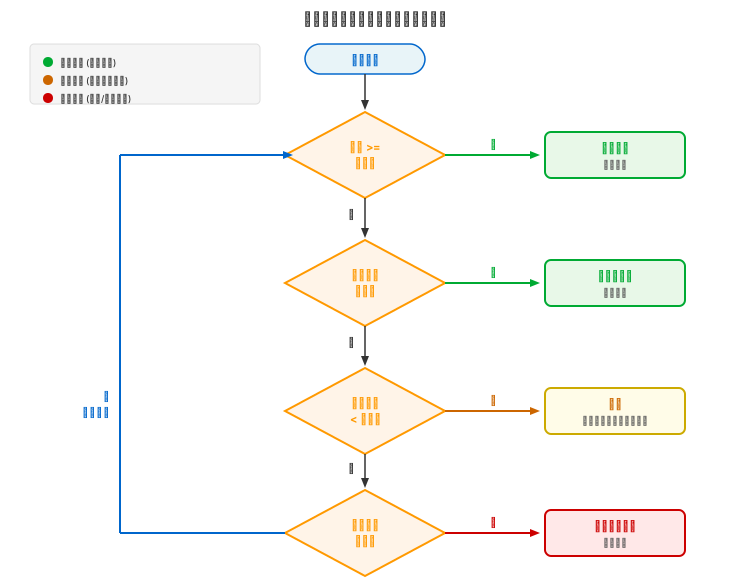
四个条件形成多层安全网:质量达标是正常退出,最大重试和成本预算是硬性保底,改进幅度检测是"聪明的"提前退出。
8.5 代码实现
@dataclass
class ReflectionPolicy:
    max_retries: int = 3
    quality_threshold: float = 0.7
    improvement_threshold: float = 0.1
    cost_limit_tokens: int = 10000

class ReflectiveAgent:
    def __init__(self, base_agent: ReActAgent, policy: ReflectionPolicy,
                 model: str = "gpt-4o-mini"):
        self.base_agent = base_agent
        self.policy = policy
        self.model = model
        self.client = openai.OpenAI()

    def _reflect(self, goal, steps, result) -> ReflectionResult:
        resp = self.client.chat.completions.create(
            model=self.model,
            messages=[{"role": "user", "content": REFLECTION_PROMPT.format(
                goal=goal, steps=json.dumps(steps), result=result)}],
            response_format={"type": "json_object"},
        )
        return ReflectionResult(**json.loads(resp.choices[0].message.content))

    def run(self, goal: str) -> str:
        best_result, best_score = None, 0.0
        history = []

        for attempt in range(self.policy.max_retries + 1):
            # 执行(重试时注入反思结论)
            if attempt == 0:
                result = self.base_agent.run(goal)
            else:
                enhanced = (f"{goal}\n\nPrevious issues: {reflection.what_went_wrong}"
                           f"\nRoot cause: {reflection.root_cause}"
                           f"\nSuggestion: {reflection.what_to_do_next}")
                result = self.base_agent.run(enhanced)

            reflection = self._reflect(goal, history, result)

            # Stop conditions
            if reflection.confidence >= self.policy.quality_threshold:
                best_result, best_score = result, reflection.confidence
                break
            if not reflection.should_retry:
                break
            if attempt > 0 and (reflection.confidence - best_score) < self.policy.improvement_threshold:
                break  # 改进幅度不足,再试也没用

            # 更新最优结果(放在 stop condition 之后,避免 improvement 检查失效)
            if reflection.confidence > best_score:
                best_result, best_score = result, reflection.confidence

            history.append({"attempt": attempt, "issues": reflection.what_went_wrong})

        return best_result or result
9. Reflection 的陷阱
9.1 无限循环
Agent 不断反思但不改进——反思发现了问题却没有提供有效的改进方向。解法:improvement_threshold 检测,连续两轮质量差距 < 0.1 直接停止。
9.2 过度反思
简单任务("今天天气怎么样")也要三轮反思,浪费 3-4 倍 token。解法:引入复杂度判断,简单任务跳过反思。
def needs_reflection(task: str, result: str) -> bool:
    """简单任务不值得反思"""
    if len(result) < 100:  # 结果很短 → 可能是简单查询
        return False
    simple_patterns = ["什么是", "查一下", "告诉我"]
    return not any(p in task for p in simple_patterns)
9.3 成本爆炸
每次反思是完整 LLM 调用,包含完整上下文。对策:(1) 反思用小模型(GPT-4o-mini);(2) 压缩上下文传摘要版本;(3) 采样反思(30% 的执行触发反思而非 100%)。
9.4 合理的 Reflection 策略
不是所有任务都需要反思。决策树如下:
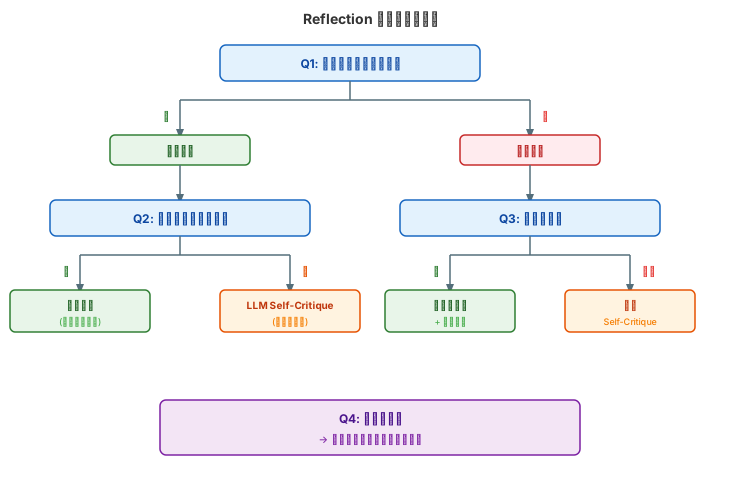
四个问题形成分层筛选:
- Q1:错误成本高吗? 低成本任务(闲聊、简单查询)直接跳过反思,省 token。
- Q2:错误可自动检测吗? 可以就用外部验证(代码跑测试、SQL 查结果),比 LLM Self-Critique 更可靠也更便宜。
- Q3:预算够吗? 够就上结构化反思 + 多轮重试(最多 3 轮),不够就单轮 Self-Critique 兜底。
- Q4:延迟敏感? 是的话最多一轮反思,超时直接返回当前最优结果。
一句话总结:先判断值不值得反思,再选择反思方式,最后用预算和延迟做硬约束——这套决策逻辑可以直接写进 Agent 框架的配置层。
10. 规划模式选择清单
在实际项目中,选择哪种规划模式不需要从零推导——下面的决策清单可以直接用:
| 场景 | 推荐模式 | 原因 |
|---|---|---|
| 简单工具调用(查天气、算术) | ReAct | 1-2 步完成,规划是过度设计 |
| 多步研究(竞品分析、技术调研) | Plan-and-Execute | 需要全局视野和步骤追踪 |
| 创意/数学/代码 | Tree-of-Thought | 需探索多条路径并选最优 |
| 复杂项目(系统设计) | Hierarchical | 粒度跨度大,需递归分解 |
| 高可靠(金融/法律) | Plan-and-Execute + Reflection | 全局规划 + 结果验证 |
| 实时交互(客服/对话) | ReAct | 延迟敏感,逐步响应 |
| 长时任务(数据管道) | Hierarchical + Plan-Exec | 可中断、可恢复、可并行 |
Token 成本与延迟的实际对比(以"调研某技术方案的可行性"这类 5-8 步任务为例估算):
| 模式 | LLM 调用次数 | 估算 Token 消耗 | 典型延迟 | 成本特征 |
|---|---|---|---|---|
| ReAct | N(步数) | 步数增长导致上下文线性膨胀:5 步约 15K-25K tokens | 10-20s | 后期步骤越来越贵(上下文累积) |
| Plan-and-Execute | 1(规划)+ N(执行)+ 可能 1(综合) | 规划 2K + 每步 3K-5K + 综合 3K ≈ 25K-40K tokens | 15-30s | 前期规划一次性开销高,但执行期上下文不膨胀 |
| Tree-of-Thought | N × B(分支数) | 3 分支 × 5 步 ≈ 60K-100K tokens | 30-60s | 成本随分支数线性增长,适合高价值决策 |
| Hierarchical | M(子目标)× N(每目标步数) | 分解 3K + 3 个子目标 × 15K ≈ 50K-60K tokens | 20-40s | 总量高但可并行执行子目标,实际延迟可能低于 ToT |
| ReAct + Reflection | N + R(反思轮数) | 5 步 ReAct 25K + 2 轮反思 8K ≈ 33K tokens | 15-30s | 反思调用可用小模型降成本 |
这些数字是估算量级,实际取决于工具返回值大小和模型选择。核心规律:ReAct 的成本随步骤数超线性增长(上下文累积),Plan-and-Execute 的成本近似线性增长(执行期上下文可控)。当任务超过 6-7 步时,Plan-and-Execute 通常比 ReAct 更省钱。
二维决策矩阵:
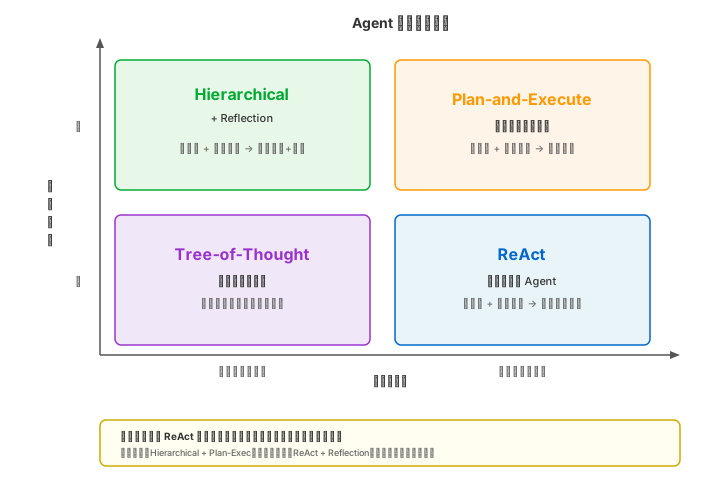
模式组合在生产中很常见:Hierarchical + Plan-and-Execute(高层分解子目标,内部用 Plan-Exec 执行);ReAct + Reflection(逐步执行,每 N 步检查方向)。关键原则:从 ReAct 开始,只有当它的局限性确实成为瓶颈时再升级。
11. 结语:规划的边界与 Multi-Agent 的必要性
规划和反思让单个 Agent 从"走一步看一步"进化到"先想后做再检查"。但单 Agent 的规划能力终有上限:
- 上下文窗口限制:任务涉及的知识和状态超出 context window 时,单 Agent 力不从心
- 专业性限制:一个 Agent 很难同时擅长编码、写作和数据分析——就像一个人很难同时是程序员、设计师和产品经理
- 执行效率限制:单 Agent 串行执行,即使计划中的步骤可以并行
当这些限制成为瓶颈,你需要的不是更好的规划算法,而是多个 Agent 的协作——每个 Agent 专注于擅长领域,由 Orchestrator 协调。
进一步思考:
- 规划质量高度依赖 LLM 对任务域的理解。如果 LLM 从未见过某类任务,能否通过 few-shot examples 注入领域知识来提升规划质量?
- "LLM 评估 LLM" 的反思机制在多大程度上可靠?是否能引入外部验证信号(代码测试、人类反馈)来补强?
- Tree-of-Thought 的搜索空间是指数级的。能否借鉴 AlphaGo 的 MCTS 来更高效搜索?Reasoning model(如 o1、o3)是否已在内部做了类似的事情?
- 规划和反思的 token 成本显著。能否缓存和复用已有的计划,为相似任务跳过规划阶段?